Dynamic Programming – Learn to Clear up Algorithmic Issues & Coding Challenges
Warning: Undefined variable $post_id in /home/webpages/lima-city/booktips/wordpress_de-2022-03-17-33f52d/wp-content/themes/fast-press/single.php on line 26
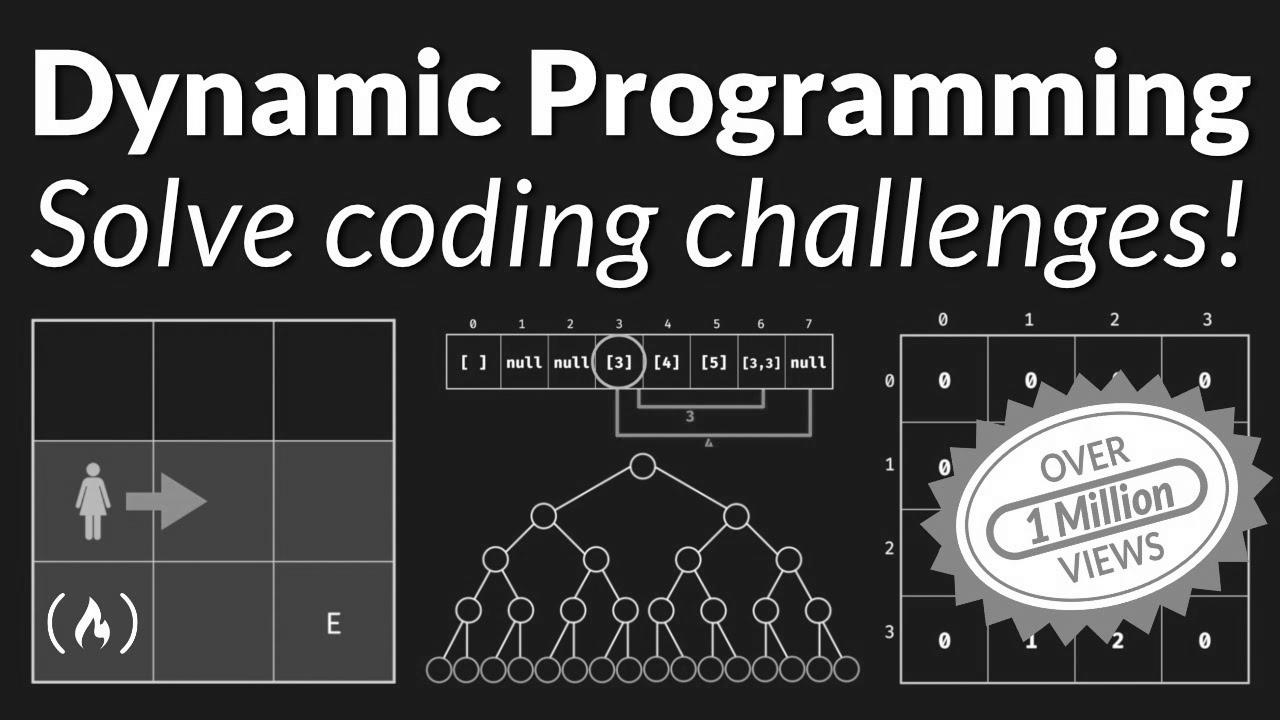
Study , Dynamic Programming - Be taught to Solve Algorithmic Problems & Coding Challenges , , oBt53YbR9Kk , https://www.youtube.com/watch?v=oBt53YbR9Kk , https://i.ytimg.com/vi/oBt53YbR9Kk/hqdefault.jpg , 2309657 , 5.00 , Discover ways to use Dynamic Programming in this course for freshmen. It can assist you to solve advanced programming problems, such ... , 1607007022 , 2020-12-03 15:50:22 , 05:10:02 , UC8butISFwT-Wl7EV0hUK0BQ , freeCodeCamp.org , 75276 , , [vid_tags] , https://www.youtubepp.com/watch?v=oBt53YbR9Kk , [ad_2] , [ad_1] , https://www.youtube.com/watch?v=oBt53YbR9Kk, #Dynamic #Programming #Learn #Resolve #Algorithmic #Issues #Coding #Challenges [publish_date]
#Dynamic #Programming #Learn #Solve #Algorithmic #Issues #Coding #Challenges
Learn how to use Dynamic Programming in this course for beginners. It could allow you to remedy complicated programming problems, such ...
Quelle: [source_domain]
- Mehr zu learn Encyclopaedism is the procedure of acquiring new disposition, noesis, behaviors, trade, belief, attitudes, and preferences.[1] The cognition to learn is demoniac by human, animals, and some machinery; there is also inform for some kinda learning in convinced plants.[2] Some encyclopaedism is immediate, elicited by a separate event (e.g. being unburned by a hot stove), but much skill and cognition accumulate from continual experiences.[3] The changes evoked by learning often last a life, and it is hard to identify knowing fabric that seems to be "lost" from that which cannot be retrieved.[4] Human encyclopaedism get going at birth (it might even start before[5] in terms of an embryo's need for both physical phenomenon with, and freedom within its environs within the womb.[6]) and continues until death as a consequence of current interactions 'tween fans and their situation. The trait and processes caught up in eruditeness are studied in many established fields (including informative scientific discipline, neuropsychology, psychonomics, psychological feature sciences, and pedagogy), besides as nascent comic of noesis (e.g. with a shared refer in the topic of encyclopedism from device events such as incidents/accidents,[7] or in collaborative learning condition systems[8]). Look into in such william Claude Dukenfield has led to the designation of diverse sorts of encyclopaedism. For instance, encyclopedism may occur as a result of physiological state, or conditioning, operant conditioning or as a event of more complicated activities such as play, seen only in comparatively natural animals.[9][10] Encyclopedism may occur consciously or without cognizant consciousness. Learning that an dislike event can't be avoided or escaped may issue in a condition called learned helplessness.[11] There is testify for human activity eruditeness prenatally, in which physiological state has been determined as early as 32 weeks into maternity, indicating that the important uneasy organisation is insufficiently matured and primed for encyclopaedism and memory to occur very early on in development.[12] Play has been approached by individual theorists as a form of education. Children inquiry with the world, learn the rules, and learn to act through play. Lev Vygotsky agrees that play is pivotal for children's maturation, since they make signification of their environs through and through performing arts learning games. For Vygotsky, yet, play is the first form of encyclopaedism terminology and human action, and the stage where a child begins to realise rules and symbols.[13] This has led to a view that eruditeness in organisms is ever related to semiosis,[14] and often associated with figural systems/activity.
In canSum memoization around 1:21:30… array numbers are said to be non negative. say the first element of the array is zero , then cansum() will go in infinite loop…right ?
3:52:52 the space is actually the size of the largest value in the numbers array, (due to growing the array to i + num) which could be way larger than the target value (unless I am misunderstanding and the array becomes sparsely represented for a huge index so not memory hungry)
Thank you so much!
"potentpot" hmmm
F' I am so stupid 🙁 my brain hurts. PLZ do this in c++
Amazing, simply amazing!
Can you please try and solve the "skateboard" example for canConstruct with the tabulation strategy. It doesn't look possible to solve it with tabulation strategy discussed here.
7:38
The best explanation I've ever had! Thanks
This is one of the best videos that explain DP very well.
Finally done!!!! 🎆
32:00
1:10:28
AMAZING course! Thanks Alvin.
A quick question please – is it me or does the canSum function fail when you pass in 0 as the target? It returns true irrespective of the array of numbers.
So I watched this, I agree it's very good for what it is . The examples are contrived to hammer home similar points. My question: how do these same exact problems change when you do NOT allow choosing the same elements repeatedly in the sets, and those sets are much, much larger?
Nothing can be as useful as this video on YT.
Thanks!
This is a great tutorial, thank you Alvin.
Just and advice for new comers, don't try so hard the tabulation part, it's not intuitive, the algorithms used overther are not generalistics and there is not any recipe that works totally for them (contrary to memorization) , there are enormous jumps on the logic, and it's ok no worries, with memorization part it's enoght to pass the problems. Success!
You lost me at 1/2 simplifies to 1
i just want to thank you n^m times🙏🙏🙏🙏🙏🙏🙏🙏🙏
This is an amazing course! Thank you for sharing this with us! Just curious, is there any way we can have access to the illustrations? They are also amazing and would be great to keep in some notes. Thank you!
Just completed the course and this is awesome! Thank you so much!!!
How CanSum(7,[2,3]) will return true it should be false can someone please explain me.